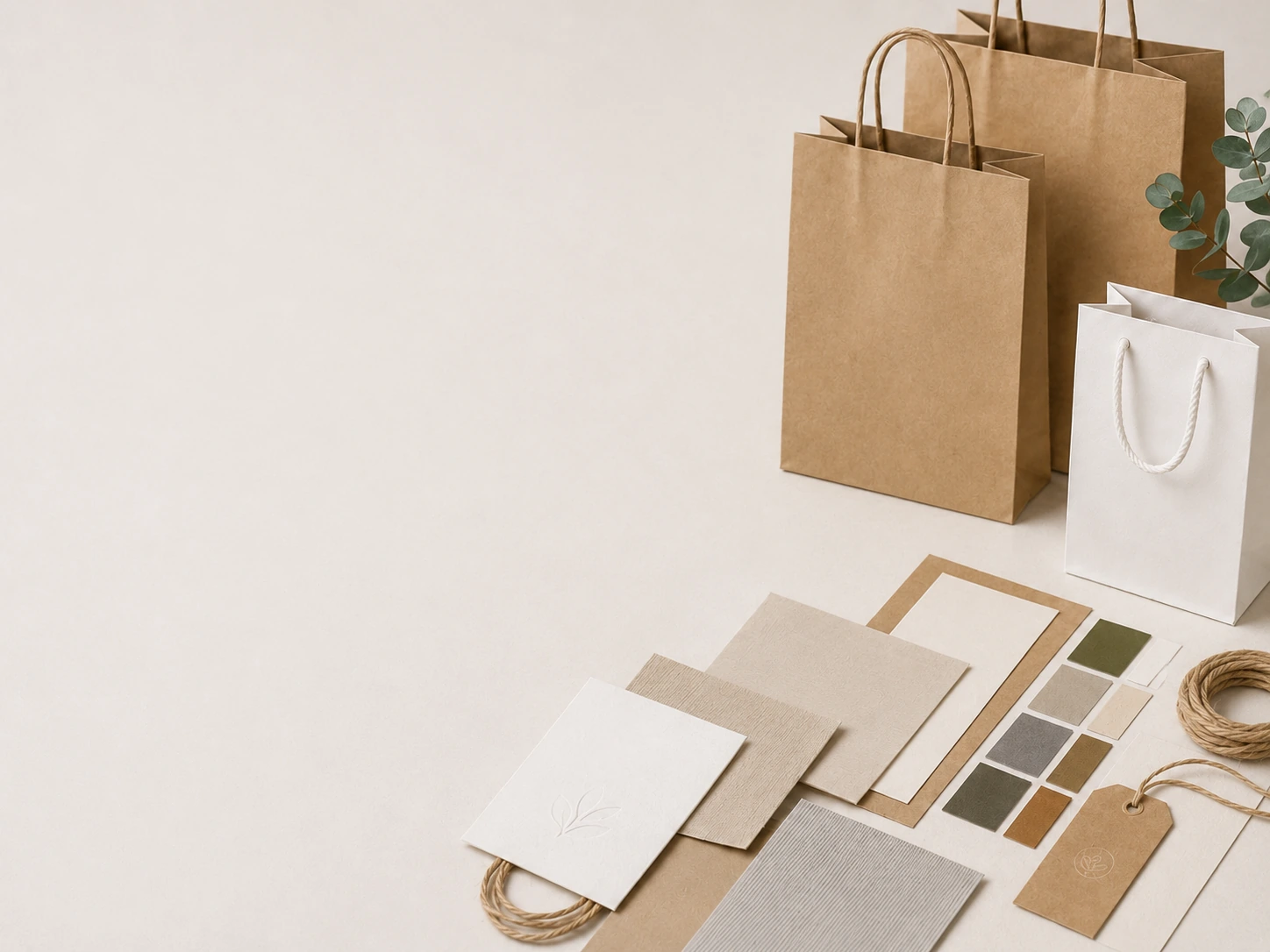
How to Choose the Perfect Paper Bag Size: A Strategic Guide for Retail & Branding
A paper bag is a silent salesperson. From measuring your product correctly to choosing between twisted or flat handles, this guide covers everything you need to know to order custom packaging that fits perfectly.

In the world of retail and branding, packaging is a silent salesperson. It greets the customer first, forms a critically important first impression, and carries your philosophy. Among the variety of packaging solutions, paper bags with handles hold a special place, acting as a symbol of eco-friendliness, style, and customer care. However, even the most beautiful branded paper bag can ruin an impression if chosen incorrectly: too small, and it risks tearing; too large, and it looks ridiculous and uneconomical. This material is a comprehensive guide that turns size selection from a routine task into a strategic decision. We will break down every aspect in detail, from bottom types to handle styles, so you can confidently order custom paper bags with logos that perfectly highlight the value of your product.
The Foundation of Choice: Key Parameters Defining Size
Before looking at the size chart, it is necessary to conduct a thorough audit of your merchandise and business processes. The wrong choice will lead not only to customer dissatisfaction but also to direct financial losses.
Dimensions and Shape: Why “Eyeballing It” Is Not Enough
The dimensions and shape of the product are the starting point, the alpha and omega of packaging selection. It is useless to choose paper bags with a rectangular bottom for a long baguette—here you need a narrow and elongated model, specifically designed as a paper bag for baguettes. For a standard-shaped cosmetic gift set, on the contrary, such an option would be the ideal solution.
- How to measure correctly? Take a tape measure and record the length, width, and height of the largest of your products. Don’t forget about allowances! The bag should not fit the product like a second skin. A technological gap of 2-4 cm in height and 1-3 cm in width/depth is necessary for comfortable and safe placement. For example, for an A4 book (approx. 21×30 cm), you should consider paper bags with a flat bottom measuring at least 25×35 cm so that it enters and exits freely without creasing at the corners. What happens if you neglect the gap? The bag will tear at the seams, the corners of the product will crumple, and the packaging process will turn into torture for your employee.
- Consider asymmetry and fragility
For products with complex shapes or fragile items (Christmas ornaments, ceramics), the gap should be even larger, and the packaging itself requires additional cushioning material. In such cases, ready-made paper bags of standard sizes, but with increased internal space, are especially helpful.
Product Weight and Paper Density: A Question of Strength, Not Just Looks
This parameter directly dictates not only the size but also the choice of material. Light paper bags without handles made of thin paper may be suitable for lightweight confectionery, but they are categorically unsuitable for a heavy wine bottle or electronics.
What is density and why is it important?
Paper density is measured in grams per square meter (gsm). The heavier the item, the higher this figure should be. For heavy items, dense white kraft bags with flat handles are not just a style choice, but a necessity. Flat handles, sewn into the bag seams, distribute the load better than standard twisted ones, making carrying comfortable even with substantial weight. If you ignore this parameter, the handles may tear off, and the bottom may burst right at the store exit, causing irreparable damage to your reputation. Manufacturing paper bags with handles allows controlling this parameter at all stages, guaranteeing that every kraft bag with a rectangular bottom will withstand the declared load.
Intended Use: What Exactly Is the Bag For?
Ask yourself: how will the bag be used throughout its entire lifecycle? Will it be a paper bag for pastries that the customer carries home, or is it a gift kraft bag that must impress with its look even before being handed over?
Logistics and Storage
For food delivery, where speed and convenience are important, standard-sized affordable paper bags with handles are ideal. For expensive jewelry, small but surprisingly dense and stylish packaging will be required, possibly even kraft bags with a window so the item is visible. Also, consider storage: paper kraft bags with a rectangular bottom are more stable and convenient for stacking, while models with a V-shaped bottom take up less space when folded, which is critical for limited storage areas.


Maximum Customer Trust
Certificates, quality, and stable supply — a plus for your business.
Anatomy of a Bag: Bottom, Handles, and Their Impact on Functionality
Size is not just numbers on a blueprint. It is a complex characteristic closely linked to structural features. Understanding the differences between bottom types and handles will allow you to make not just the right, but the optimal choice for your business.
Bottom Construction: From Economical V-Shaped to Solid Rectangular
The bottom construction is the basis of strength and convenience. It determines whether the bag will be stable, how much weight it will withstand, and how it can be stored.
- Paper bags with a V-shaped bottom: A classic for light items Paper bags with a V-shaped bottom (also known as pinch bottom) are a genre classic. They are economical to produce, fold easily, and are ideal for light and non-bulky items: souvenirs, cosmetics, small candy sets. However, for heavy or bulky things, they are not as reliable, as the entire load is concentrated in the bottom corner. Kraft bags with V-bottoms are an excellent choice for fashion retail or the beauty sphere, where lightness and minimalism are important.
- Kraft bags with a rectangular bottom: Stability for substantial purchases
Kraft bags with a rectangular bottom (block bottom) are a sign of solidity. Thanks to the flat base, such bags stand stably on surfaces, which is extremely important when selling items like wine bottles, electronics, or multi-component gift sets. They withstand significantly more weight and are visually perceived as more premium. For the food service sector, for example, for packaging lunches or grocery sets, paper food bags with a block bottom are indispensable, ensuring reliability during transport. If your product requires stability and a solid look, then a paper kraft bag with a flat bottom is the only solution.
Evolution of the Handle: Functionality, Ergonomics, and Aesthetics
The handle is the main interface of customer interaction with your packaging. The comfort of carrying, weight perception, and overall brand impression depend on its type.
- Paper bags with twisted handles: Universal balance Paper bags with twisted handles are the most versatile and common option. They are strong, pleasant to the touch, and perfect for medium-sized and medium-weight bags. A kraft paper bag with twisted handles looks great in eco-styling. However, for very heavy loads, they can dig into fingers. White kraft bags with twisted handles look more elegant and are often used by premium segment brands.
- Paper bags with flat handles: Comfort and solidity
The alternative is paper bags with flat handles. These handles, often made of dense paper, are glued or stitched into the body, allowing for more even weight distribution. They are the ideal choice for custom paper bags with logos in the premium segment. White kraft bags with flat handles are a classic option for expensive purchases that speak to the brand’s status. - When can you do without handles?
For very light items or where minimizing cost is important, there are paper bags without handles (SOS bags)—this is an excellent solution for pre-packing, inner packaging, or small souvenirs that fit into a purse. Bakeries and confectioneries often seek to buy kraft bags without handles for packaging small pastries.
Universal Size Chart and Practical Selection Recommendations
Now, armed with theory, let’s move to practice. Below is a detailed table linking typical product groups with recommended bag sizes and constructions. This is your main tool for making the right decision.
Note: Dimensions are usually typically listed as Width x Depth x Height (W x D x H) for block bottom bags.
| Product Category | Recommended Size (cm) Approximate | Bottom Type | Handle Type | Key Recommendations |
|---|---|---|---|---|
| Small cosmetics, souvenirs, confectionery (macarons, cookies) | 15x10x20 (Block) or 20×30 (V-shape) | V-shaped or small Rectangular | No handles, twisted, or flat | Small kraft bags with handles are ideal. For product visibility, consider kraft bags with a window. |
| Bottle of wine, premium alcohol | 12x12x35 or 15x15x40 | Strictly Rectangular | Flat or reinforced twisted | Key parameters are height and strength. Choose dense white kraft bags with flat handles. |
| Clothing (t-shirt, sweater), scarf | 30x20x40 or 35x25x45 | Rectangular | Twisted, flat, rope | A bag is needed where the item can be folded neatly. Wholesale paper bags with handles of this size are economically beneficial for retail. |
| A4 Book, catalog, documents | 25x35x10 (landscape) | Rectangular or V-shaped | Flat (comfortable to carry under arm) | A paper bag with a flat handle is the best choice. It preserves the presentable look of documents. |
| Takeout lunch, grocery set | 20x15x30 or 25x20x35 | Rectangular, possibly reinforced | No handles or with flat handles | Grease resistance is important. Look for paper bags for food products with appropriate certificates. |
| Large appliances, gift sets | 40x30x50 and larger | Only reinforced Rectangular | Wide flat or rope | Maximum strength is required. Dense paper bags with double walls or kraft bags with sturdy handles. |
How to Use the Table and Go Beyond It?
This table is a starting point. Always consider the individual features of your product. For example, if you sell paper bags for bread and pastries, a baguette will require a long and narrow bag, while a round loaf will need a wider one. If your business is related to flower delivery, then kraft bags for flowers with a wide opening and a strong bottom will be fundamentally important.
Three Golden Rules for the Final Choice:
- Always request samples. Don’t hesitate to ask the manufacturer, such as Vita Group, for physical samples. Feel the paper, check how the handles are attached, and test the bag with your product.
- Conduct field tests. Ask employees to pack the product several times, carry the filled bag around, and evaluate the convenience. This small test will prevent mistakes.
- Think about print runs. Ordering custom paper bags allows you not to depend on standard grids and create packaging that meets your unique requirements 100%, whether it’s a non-standard size or special density. for large chains, wholesale kraft bags with handles are the most profitable solution.
The Final Touch: Brand Integration and Closing Tips
So, the size and construction are defined. But the work doesn’t end there. Now your packaging must speak the language of your brand. Custom paper bags with logos are a powerful marketing tool that works for you long after the purchase is made.
Logo Application: Turning Packaging into a Promotion Tool
High-quality printing turns a standard white paper bag with handles into a recognizable attribute of your company. Technologies allow applying bright and durable images even on the textured surface of brown kraft bags, emphasizing their natural aesthetic. Printing on paper bags is the final touch that anchors the brand image in the consumer’s mind. You can buy ready-made paper bags with logos or order custom paper bags for the specific needs of your marketing campaign.
Eco-friendliness as a Competitive Advantage
Remember that by choosing paper bags, you are making a conscious step towards sustainability. Unlike plastic, they decompose significantly faster and can be recycled. This message itself is a powerful marketing signal for the modern, responsible consumer. Paper bag production using responsible wood sources is something our company takes pride in.

Eco-Friendly Choice
Sustainable and biodegradable packaging to support your green image.
See Eco BagsWhere to Order? Key Criteria for Choosing a Supplier
The optimal solution for a business of any scale is to find a reliable partner who offers both paper bags with handles to buy in small batches and wholesale kraft bags with handles for large chains. Working directly with a manufacturer, you get favorable prices, full quality control, and the ability to create truly unique products. Before placing a final order, ensure the supplier offers a full cycle of services: from consultation and design to printing paper bags with logos and delivery. Create the perfect packaging that will delight you and your customers, strengthening your brand’s reputation with every purchase made.
Maximum Customer Trust
Certificates, quality, and stable supply — a plus for your business.