When a Custom Bag Size Pays Off
Most businesses start with a standard paper bag: a familiar size from the manufacturer’s range, printed with the logo. It is a sensible choice, and for many it remains the right one. Sooner or later, though, the question comes up: would a bag made to the exact size of our product work better? A custom […]
Most businesses start with a standard paper bag: a familiar size from the manufacturer’s range, printed with the logo. It is a sensible choice, and for many it remains the right one. Sooner or later, though, the question comes up: would a bag made to the exact size of our product work better? A custom bag size can improve fit, speed and presentation, but it is not automatically worth it. This article explains when it pays off, when a standard size is the better decision, and how to specify a custom size properly.
The case for one standard size
Before looking at custom sizes, it is worth recognising what a single standard size does well.
- Simple purchasing. One item to order, one item to count, one reorder point.
- Concentrated volume. Custom-printed bags are produced from 30,000 units per design. A single size reaches that quantity faster than several sizes sharing the same demand.
- Simple packing. Staff do not have to choose; every order goes into the same bag.
- A consistent look. The customer always sees the same bag, which supports brand recognition.
If your products vary in shape and size, and none of them dominates your sales, a well-chosen standard size is often the most efficient solution. Our guide on how to choose the perfect paper bag size covers how to pick it.


Maximum Customer Trust
Certificates, quality, and stable supply — a plus for your business.
Signs that a standard size is not working
A standard size becomes expensive when it no longer fits the way you sell. Typical warning signs:
- Your main product sits loosely in the bag and tips over, or only just fits and strains the seams.
- Staff regularly fold the top down, tape it, or put one bag inside another.
- Products arrive damaged because they moved around in the bag.
- The bag looks oversized next to a premium product and undermines the impression you want to create.
- Couriers or shelves run out of space because the bags are larger than they need to be.
If you recognise two or three of these, it is time to compare options.
When a custom bag size pays off
Your product has fixed dimensions
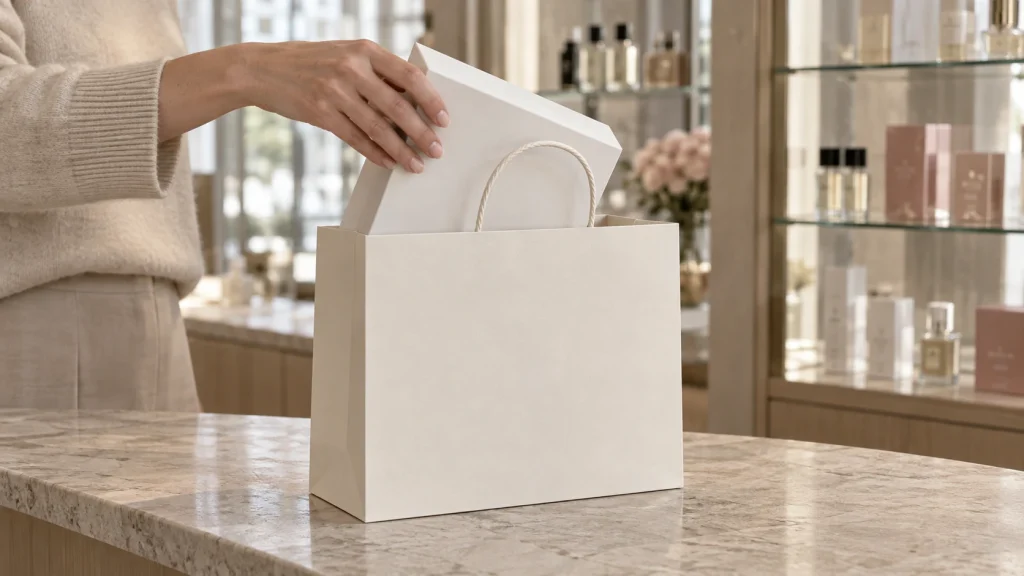
Boxed goods such as cakes, shoes, cosmetics sets, toys or gift boxes have the same dimensions every time. A bag made for that box holds it upright, protects the corners and looks deliberate. This is the clearest case for a custom bag size.
You sell that product in volume
A custom size makes sense when the product it is made for accounts for a large share of your orders. If the bag will be used tens of thousands of times, small gains per order add up quickly.
Packing speed matters
When the bag matches the product, packing becomes a single movement: open, insert, close. No folding, no padding, no second bag. In delivery and e-commerce, where the same product is packed many times a day, this is often where the benefit is largest.
Presentation is part of the product
In fashion, gifts and premium food, a bag that fits neatly is part of the experience. A box sitting snugly in its bag looks considered; the same box lost in a larger bag does not.
Weighing the cost
The decision is easier with numbers in front of you, and they should come from a quotation rather than from assumptions. A few points to keep in mind:
- The minimum order is the same. Standard custom-printed bags are made from 30,000 units, whether the size is from the range or not.
- The lead time is similar. A new printed order takes about three to four weeks from artwork approval.
- Price depends on the specification. Size, construction, paper and print all affect it. Ask for a quotation for both the standard and the custom option, so you compare like with like.
- Count the hidden costs of the standard size. Extra tape, second bags, damaged goods and slower packing rarely appear in the packaging budget, but they are real.
If the custom size removes those hidden costs and the product is sold in volume, it usually pays off. If the gain is mainly cosmetic and the volume is small, a standard size is the safer choice. The full ordering process is described in our step-by-step guide to ordering custom packaging.
A note on folded top bags
Folded top bags, where the top edge is folded inside and the handles are fixed under the fold, are a special case: they are made to the size agreed with the client, so for this construction a custom size is the normal route rather than an extra. Size, paper and quantity are agreed for each order, so ask your manager for current terms.
How to specify a custom size
- Measure the product as it will be packed, including its box or wrapping.
- Add an allowance so the product goes in easily and the bag closes neatly. Too tight is as bad as too loose.
- State the size as width × gusset × height in millimetres, and say how the product sits in the bag: upright or flat.
- State the weight of the heaviest item or set the bag will carry.
- Test with samples. Free unprinted samples of our constructions are available from stock, so you can check the fit with similar sizes before ordering.
- Prepare the artwork for the new dimensions. Send print-ready vector files (AI, EPS or PDF) built to the final size; our prepress team checks them technically.
The bottom line
A standard size is simple and efficient when your products vary. A custom bag size pays off when one product with fixed dimensions sells in volume, when packing speed matters and when the bag is part of the presentation. Compare quotations for both options, include the hidden costs of a poor fit, and test before you commit.
Considering a custom size? Send us the dimensions and weight of your product, and we will prepare a quotation for the options.
Bags That Sell
Order packaging with your logo and boost brand awareness.